
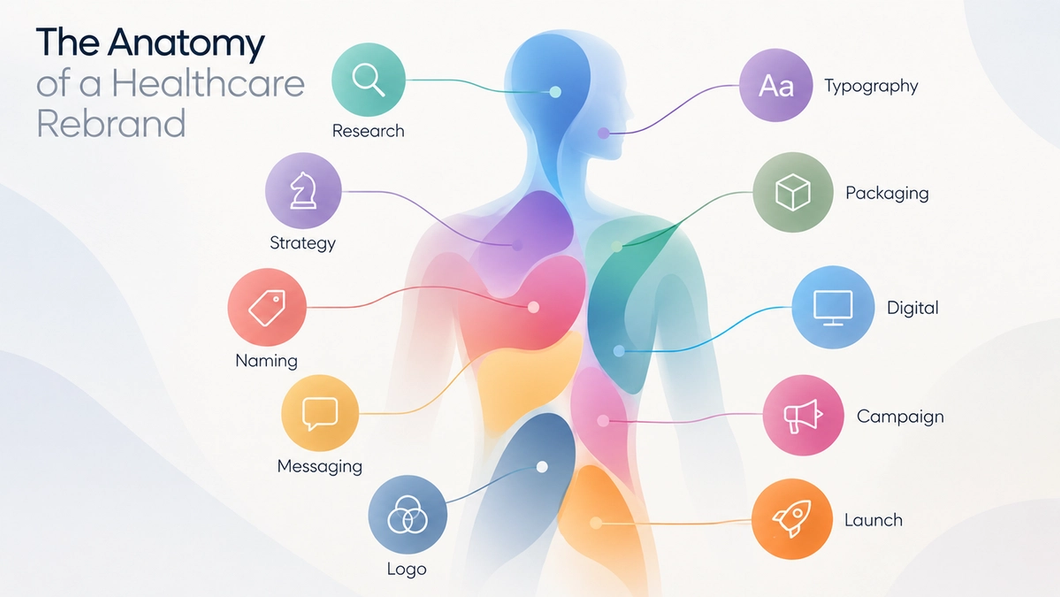
The Anatomy of a Healthcare Rebrand
How to Rebrand a Healthcare Company or Product in Ireland
Rebranding a healthcare company or product is never just about designing a new logo, which is only one of the later parts of a much bigger process.
A successful rebrand starts with understanding the market, the audiences, the competitive landscape and what the organisation or product needs to stand for. From there comes positioning, naming, messaging, visual identity, packaging, digital applications, launch planning and ultimately the promotional strategy that takes the new brand into the market.
In healthcare, there is another layer too.
Brands need to be distinctive and engaging, but they also operate in an environment where trust, credibility, accessibility and regulatory considerations are fundamental.
That means the best healthcare rebrands combine strategy, creativity and practical implementation from the very beginning.
So, where do you start?
1. Start with discovery, not design
The temptation with any rebrand is to jump straight to colours, logos and creative routes.
Don't!
The first stage should always be about understanding where the brand is now and where it needs to go.
For a healthcare company or product, this discovery stage might involve speaking to internal stakeholders such as company owners and directors, senior management, medical teams, and sales and marketing teams. Then externally stakeholders such as HCPs, Pharmacists, Patients and carers and Distributors or channel partners may also need to be consulted.
Ask questions such as,
What does the current brand stand for?
What are people saying about it?
What is working and what isn't?
Who are our competitors?
What makes this company, service or product genuinely different?
And perhaps most importantly:
What do we want people to think, feel or understand differently after the rebrand?
This stage can include stakeholder interviews, workshops, customer research, competitor reviews, audits of existing communications and analysis of how the brand currently appears across channels.
The objective isn't research for research's sake. It’s about uncovering the insight that will ultimately drive the brand.

2. Define the positioning
Once the research is complete, the next job is to decide what the brand should stand for.
This sounds obvious, but it is where many branding projects become difficult.
Healthcare organisations often work in categories where competitors use very similar language. For example, Innovation, Care, Quality, Expertise, Patients first, Better outcomes…etc.
All of these may be true. But if every competitor is saying something similar, they are unlikely to give your brand a distinctive position.
Strong positioning should answer three questions:
- Who are we for?
- What do we uniquely offer?
- Why should anyone believe us?
For a healthcare company, that positioning might come from clinical expertise, specialist knowledge, patient experience, technology, service, reach, partnership or some other demonstrable strength.
For a product, the positioning may be more tightly focused on a specific customer need, product benefit, evidence base or role within the category.
The important thing is to land on something credible, relevant and ownable.
That positioning then becomes the foundation for everything that follows.
3. Build the brand strategy around it
With the positioning established, the broader brand framework can be developed.
Depending on the project, this may include brand purpose, mission and values, brand personality, tone of voice and key messaging
This doesn't have to result in a 100-page strategy document. Actually, the strongest brand platforms are often the simplest.
Everyone involved in the organisation should ultimately be able to understand what the brand stands for and what makes it different.
If it takes twenty minutes to explain, it probably isn't clear enough yet.
4. Naming: where creativity meets discipline
If the rebrand involves a new company, product or service name, this becomes one of the most important stages of the entire process.
Naming can look deceptively simple, but it rarely is. A good healthcare name needs to work on several levels at once. It should have meaning and personality, be relatively easy to pronounce. It should be memorable yet appropriate to the audiences it serves. And of course, it must work digitally.
And depending on the market, it may need to work across different countries and languages.
Then there are the practical realities: domain availability, competitor names, trademark searches and potential conflicts with other healthcare or pharmaceutical terminology.
A structured naming process normally starts by creating a number of clear naming territories. These might be built around themes such as Science, Care, Confidence, Heritage etc.
From these territories, the ideation process can begin. And this stage should be broad.
You may generate dozens — sometimes hundreds — of potential names before gradually reducing them to a shortlist.
Naming is partly subjective, but a good process gives you objective criteria against which options can be evaluated.


5. Bring shortlisted names to life
Names should not always be judged in isolation on a PowerPoint slide.
Sometimes a name that feels relatively ordinary as a word becomes much more interesting when you see the story, identity and positioning behind it.
That's why shortlisted names can benefit from some early creative exploration.
What might the logo feel like?
What would the brand look like on a website?
How could the name appear on packaging?
How might it sound in a headline?
Does it feel right in conversation?
These early applications aren't the final identity. They're simply a way of helping stakeholders see the potential in each route. It turns naming from a vocabulary exercise into a branding exercise.
6. Create the visual identity
Only when the strategy, positioning and name are in place, should the identity begin to take shape.
This is where the brand finally starts to become visible.
The visual identity includes, logo, colour palette, typography, photography, illustration etc. But again, this shouldn't simply be about making something look attractive. Every creative decision should connect back to the strategy.
If the brand wants to feel highly scientific and authoritative, the visual language should support that. If the positioning is built around personal care and empathy, a completely different visual approach may be appropriate. If innovation is central, the identity should feel progressive rather than familiar or conservative.
Healthcare branding has traditionally leaned towards certain familiar visual conventions — blues, greens, clinical imagery, soft gradients and stock photography — which means there can be significant opportunities for brands willing to create something more distinctive while still retaining credibility.
The objective is not to be different for the sake of it. It is to become recognisable.
7. Don't forget the verbal identity
A brand doesn't just have to look right. It has to sound right too.
Tone of voice is especially important in healthcare because brands may need to communicate with very different audiences.
HCP communications might need to be concise, evidence-based and scientific. Patient-facing communication may need to be warmer, clearer and less technical. Corporate communication might need more authority.
Social content might allow more personality. The tone can flex, but it should still feel like the same organisation.
A clear verbal identity should define the language the brand uses, the language it avoids, how technical terminology is handled and how the brand adapts its voice across different audiences.
8. Packaging: where the brand meets reality
For consumer healthcare, OTC, medical devices, nutrition products and many other healthcare categories, packaging is one of the most important expressions of the brand.
It is also one of the most challenging.
Packaging has to balance creative impact with a considerable amount of functional information. A good packaging system should solve all of these questions while still feeling unmistakably part of the new identity.
And packaging shouldn't be considered separately from the brand. Ideally, it should be part of the creative development process from an early stage.
9. Test the brand in the real world
One of the best ways to evaluate a new identity is to apply it.
Not just to a logo page, but to actual communications.
These might include, a website homepage, social media post, patient leaflet, HCP leavepiece, conference stand, digital ad etc.
A brand that works beautifully in a presentation but falls apart when applied to real communications hasn't been designed properly.
Healthcare brands in particular need flexible design systems because their communications can range from highly visual campaigns to complex clinical or scientific information. The system needs to cope with both.


10. Create the guidelines — and make them usable
Once the identity is agreed, it needs to be documented. Guidelines should not become a design textbook that nobody reads. They need to be practical.
People need to understand how to use the brand correctly in everyday situations. Templates are therefore just as important as rules. Presentation decks, social templates, digital assets, document formats and campaign examples all make it easier for internal teams and external partners to use the identity consistently.
11. Plan the launch before the brand is finished
One of the most common mistakes in branding projects is treating the launch as the final step.
In reality, launch planning should begin much earlier. Lots of considerations need to be taken into account. How will existing customers discover the new brand? How will employees be introduced to it? How will sales teams explain the change? Will distributors or partners need new assets? Does the website need to go live at the same time? What happens to existing packaging and stock? What communications need to change?
But even relatively modest rebrands benefit from having a clear launch story.
12. Tell people why you've changed
A new identity alone isn't a story.
The reason behind it is.
Perhaps the organisation has evolved, or new services have been added. Perhaps two companies have come together.Or maybe the existing identity no longer represents the quality of the business.
Whatever the reason, a launch campaign should communicate that progression. This gives audiences a reason to pay attention and helps employees understand that the change represents more than a new logo.
The best rebrands often feel less like saying:
“Look at our new identity.”
And more like:
“This is where we're going next.”
13. Then start promoting it
The rebrand provides the platform. The promotion strategy builds the momentum.
This is where the new brand needs to start working consistently across paid, earned, shared and owned channels. The exact channel mix depends entirely on the audience and objective. But the important point is that brand development and marketing strategy shouldn't sit in separate worlds.
If the brand has been built around a strong insight and a clear position, that thinking should naturally feed into the campaigns used to grow it.
A rebrand is a process, not a logo project
A successful healthcare rebrand moves through a connected journey.
Research → Insight → Strategy → Positioning → Naming → Messaging → Identity → Packaging → Guidelines → Launch → Promotion.
Each stage informs the next, and if its done properly, a rebrand can do much more than modernise the way a company or product looks. It can clarify where the organisation is going, differentiate it from its competitors, and create a much stronger platform for future marketing and growth.
In healthcare, where trust and credibility are essential, that combination of strategic clarity and creative distinctiveness is particularly powerful.
Thinking about a healthcare rebrand?
At Agency X, we work with healthcare, pharmaceutical and medtech organisations through the complete brand development journey — from research, workshops, positioning and naming through to visual identity, packaging, brand guidelines, digital applications, campaign development and launch.
Because the best healthcare brands aren't simply redesigned.
They're thought through from the beginning.
Contact us today to discuss how we can collaborate to design and create your next brand campaign.We'll be delighted to help!
Similar blog posts

Does your Brand Packaging need a Design Makeover?
Why Attractive, Compliant Packaging Matters in Ireland’s OTC and Prescription Medicine Markets
Your 2026 Brand Refresh How-To
for Irish Pharma, Healthcare and Medtech
Proof Through Design:
How Exceptional Creative Powers Corporate Rebrands in Healthcare and Pharma