Why KOL Events Belong
at the Heart of Healthcare Engagement
Healthcare professionals have plenty of information competing for their attention. Published research, congress presentations, clinical updates and digital communications all have their place. Finding time to discuss what that information means in everyday practice is often more difficult.
That is where a well-planned Key Opinion Leader event can make a real difference.
Whether it brings together specialists in oncology, cardiology, dermatology or another healthcare discipline, a successful KOL event creates space for informed conversation. Experts can question emerging evidence, share experience and explore challenges with colleagues who understand the complexities of their field.
For pharmaceutical companies, these exchanges offer an opportunity to listen, learn and build constructive professional relationships. Their value depends on giving participants a worthwhile reason to contribute and ensuring that what emerges from the discussion receives proper attention afterwards.
Give experts a reason to take part
We often talk about “KOL engagement” as though engagement itself were the objective. But an invitation accepted or a seat filled tells us relatively little about the quality of the interaction.
Meaningful engagement starts with relevance. Why should this particular group of experts give their time? What question deserves their attention? What will they gain from the exchange?
The answer might be an opportunity to examine new evidence with peers, discuss a difficult aspect of clinical practice or explore an unmet educational need. Sometimes, the most valuable subject is a practical challenge that receives limited attention in a formal scientific programme.
Consider a discussion about managing a complex patient pathway. The published evidence provides an essential foundation, while clinicians bring experience of referral delays, service pressures and conversations with patients. A thoughtfully facilitated event allows those perspectives to meet.
That combination gives participants something useful to reflect on and helps pharmaceutical teams understand the context in which healthcare is delivered.


Make room for different perspectives
An effective KOL event needs a clear purpose and the right people around the table. The most recognisable names are not automatically the best fit for every discussion.
A national clinical leader may offer a broad view of a discipline. A specialist working in a regional service may identify practical barriers that look quite different. An emerging expert may bring recent research experience or a fresh approach to an established challenge.
Depending on the subject, there may also be value in involving other members of the multidisciplinary team. A discussion about a care pathway, for example, could benefit from nursing, pharmacy or allied health expertise alongside medical perspectives.
Selection should follow the scientific or advisory purpose of the event. A group chosen thoughtfully is more likely to produce a rounded discussion than one assembled around seniority alone.
The chair has an equally important role. Good facilitation draws out quieter voices, tests assumptions respectfully and allows disagreement to remain productive. Agreement can be useful; understanding why experienced clinicians disagree can be even more revealing.
Choose a format that serves the conversation
Different objectives need different event formats.
A small roundtable can give a focused clinical question the attention it deserves. An educational meeting can help participants explore developments in their discipline. A congress discussion can bring several interpretations of emerging research into one conversation. An advisory board has a distinct purpose: obtaining expert advice against a genuine, defined need.
These formats should be planned according to their respective purposes and requirements. Clarity at the outset helps participants understand what is expected and helps the organising team build an appropriate agenda.
It also prevents a familiar problem: filling the available time with presentations and leaving too little room for discussion.
If the aim is to hear expert perspectives, the agenda needs to make that possible. Short introductions, well-framed questions and sufficient discussion time can be more useful than another lengthy slide deck.
The same applies to virtual and hybrid events. Their success depends on how easily people can participate. A clear structure, confident moderation and reliable technology help remote contributors feel involved throughout the conversation.
Start the engagement before the event
The quality of an event is often shaped well before anyone joins the meeting.
An invitation should explain the purpose clearly and give participants a realistic sense of the commitment involved. Relevant background material can help establish a shared starting point, provided it is proportionate and easy to review.
There is also value in asking participants what they would find useful to discuss. A short question submitted in advance may reveal an issue that the planning team has overlooked.
For congress-related activity, early preparation is particularly helpful. Large scientific meetings cover more ground than any individual can absorb. Agreeing priority themes gives participating experts a focus while leaving room for unexpected developments.
For example, a group attending a respiratory congress might be interested in new evidence, diagnostic challenges and implications for local services. Setting those themes beforehand can make the subsequent exchange more coherent.
Preparation should make participation easier. Busy clinicians are more likely to contribute thoughtfully when the request is specific and the workload is reasonable.

Capture the insight while the context is fresh
Some of the most useful observations arise between formal sessions: a question after a presentation, a difference of interpretation or a practical concern raised during discussion.
Those details can be difficult to reconstruct later.
Without a clear approach to capture, an event may leave behind an assortment of handwritten notes, presentation files and recollections. Producing a useful account then becomes a considerable task.
A structured process helps preserve the context. What prompted the observation? Was it a personal interpretation, a shared concern or a question requiring further investigation? Did participants agree, or were there several competing views?
These distinctions matter. One expert’s response should not quietly become “the consensus”, and a discussion point should not be presented as an established clinical conclusion.
The capture process also needs to feel manageable. Participants should be able to contribute without spending the event completing forms. A few relevant prompts, supported by an agreed review process, can help retain useful detail while keeping attention on the exchange itself.

Build responsible engagement into the plan
In pharmaceutical communications, the purpose and governance of an event deserve attention from the beginning.
The applicable requirements will depend on the activity and the markets involved. Scientific and educational meetings, advisory arrangements, hospitality and transfers of value all need appropriate consideration. In Ireland, the IPHA Code provides a framework for interactions with healthcare professionals, with specific provisions relevant to meetings and advisory boards.
Bringing medical and compliance colleagues into planning early helps establish a workable approach to the agenda, participation, materials and follow-up.
The same care should extend to captured contributions. Participants need clarity about how their input will be recorded, reviewed and used. Access and permissions should reflect the intended audience.
A closed professional discussion also needs careful handling if its outputs are subsequently developed into educational or communications materials. The fact that a comment was made during an event does not automatically make it suitable for wider publication.
These considerations help create the conditions for a confident, useful exchange.
Where KOLExchange fits
Congress engagement presents a practical challenge: how do you bring together valuable observations from busy experts while the experience is still fresh?
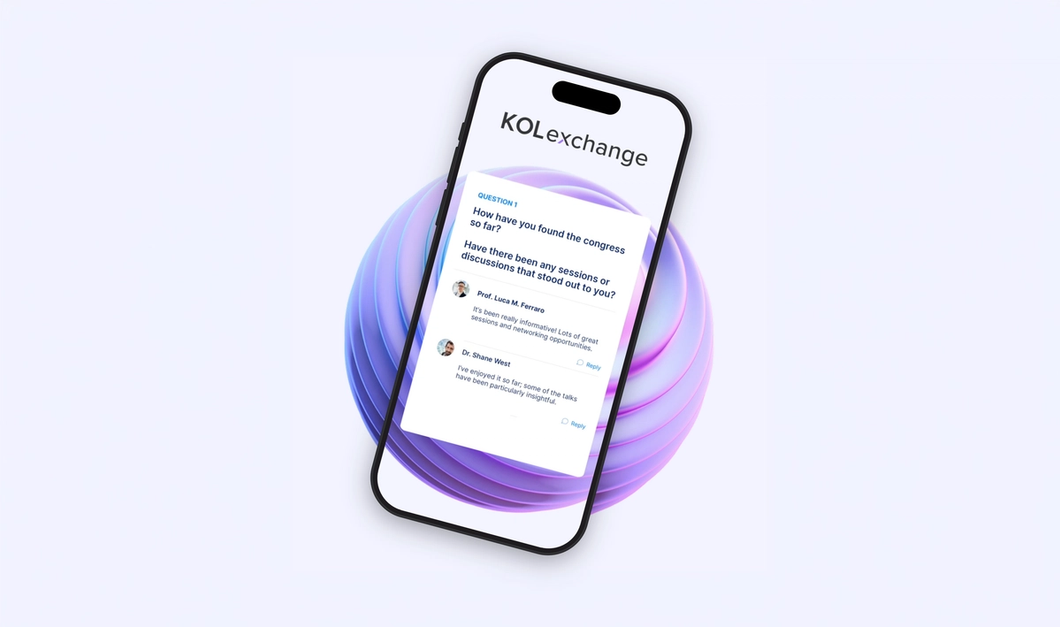
Agency X developed KOLExchange to support this exchange. It provides a collaborative hub where KOLs can share congress insights through mobile and desktop interfaces, helping teams bring contributions into a shared workspace.
The platform includes live dashboards, reporting and side-by-side comparison of KOL viewpoints. These features can help teams explore different interpretations and identify themes worth discussing further.
Its governance features include single sign-on, role-based access, moderation and versioned records. KOLExchange is designed to support pharmaceutical industry codes of practice; supporting an organisation’s governance processes rather than replacing the decisions and responsibilities of its medical and compliance teams.
For pharma clients planning congress activity, it offers a practical way to connect expert participation with organised insight capture and review. The technology gives the exchange a structure, while the value continues to come from the people contributing and the questions being explored.
Give the discussion a useful next step
An event’s value becomes clearer in what happens afterwards.
A considered follow-up might summarise the main themes, acknowledge differences of opinion and identify questions that remain unanswered. Where appropriate, it can also explain the next steps arising from participants’ contributions.
Those next steps need not mean another event. A discussion might reveal a need for clearer educational materials, further examination of a particular question or a more focused conversation with another group of specialists.
Evaluation should reflect the original purpose. Attendance provides useful context, but teams should also consider the relevance of the discussion, participants’ experience and the quality of the insights captured.
Over time, this creates a more purposeful approach to KOL engagement. Each interaction has a reason to happen and a useful place within the wider relationship.
At Agency X, we believe the strongest healthcare events give expert conversation the attention it deserves. Thoughtful planning, good facilitation and tools such as KOLExchange can help that conversation continue beyond the meeting, giving both participants and pharmaceutical teams more value from the time they invest. Visit https://kolexchange.com/ to learn more.
Contact one of our Events managers at Agency X today to discuss how we can help plan your upcoming Corporate Conference or Event.We'll be delighted to help!